
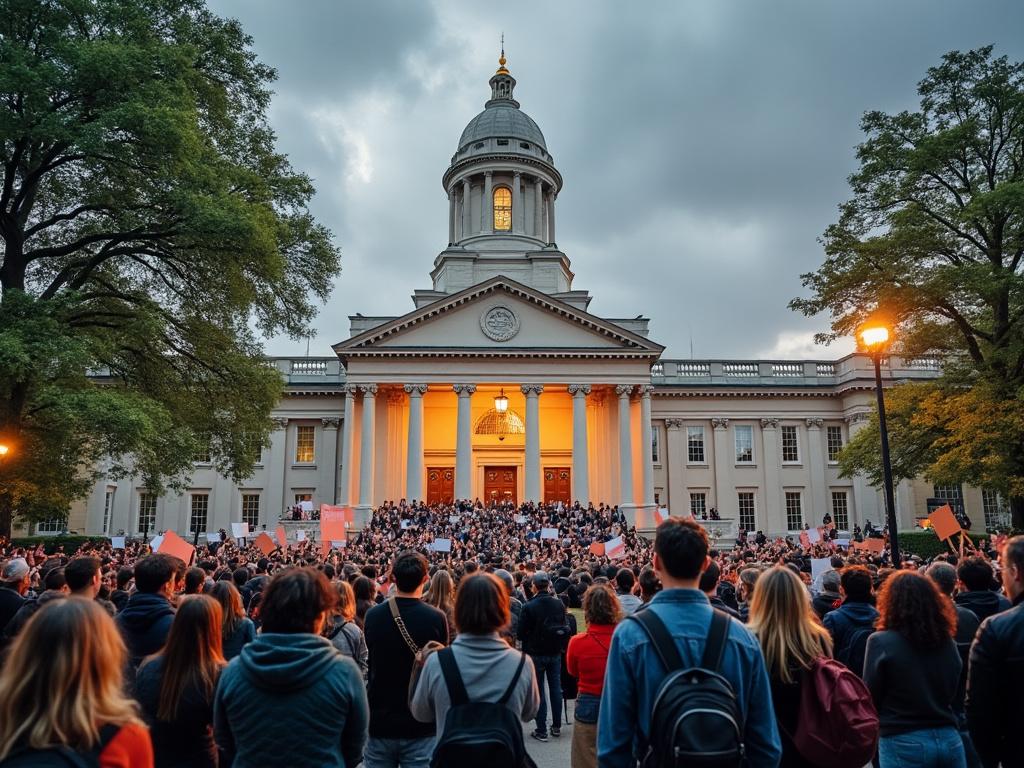
In a recent twist of events, comedian and commentator Bill Maher has sparked debates by supporting Donald Trump’s radical measures to reform American universities, criticizing them as ‘indoctrination factories’ lacking in ideological diversity.
The Core of Maher’s Critique
Bill Maher’s denouncement of America’s higher education institutions rests primarily on what he perceives as a homogenization of ideological perspectives, predominantly tilting towards liberalism. This, according to Maher, stifles the genuine pursuit of intellectual diversity, effectively shutting down conservative voices and turning these campuses into what he refers to as ‘indoctrination factories’. He argues that such an environment discourages critical thinking and debate, qualities essential to a robust educational experience. Maher highlights incidents where conservative speakers were disinvited or met with hostility, using these as evidence of a broader systemic issue within academia. His concerns resonate with wider discussions on free speech and the role of universities in fostering an inclusive intellectual landscape.
Trump’s Targeted Reforms
Donald Trump’s administration, cashing in on criticisms like those from Bill Maher about ideological bias in academia, has launched significant reforms aimed at top U.S. universities. These institutions, under policies enacted largely through threats of funding withdrawal, are accused of not only fostering a liberal bias but also of allowing antisemitic sentiments to proliferate under their watch. Specific allegations have placed universities such as Columbia, Harvard, and Yale under scrutiny, prompting federal inquiries that could potentially strip them of crucial research monies. These actions, justified by the administration as promoting an ideological balance and combatting discrimination, underscore a tension between federal influence and university autonomy. These targeted reforms, representing a significant shift in education policy, are positioned as a counterbalance against what has been described as a unilateral academic environment.
Responses to Academic Policies
In the wake of Trump’s targeted reforms of academia, responses have been diverse and intensely partisan. Bill Maher, usually a critic of the right, has surprisingly defended these actions, arguing that universities have devolved into “indoctrination factories” rather than institutions of free thinking. This perspective resonates with some conservatives, who applaud the push for what they see as ideological balance. Conversely, many in the academic world view these interventions as a direct threat to academic autonomy. University administrators have expressed concerns about the potential loss of federal funding being used coercively, which they argue could jeopardize the very foundation of academic freedom and intellectual exploration. This polarized response highlights a broader cultural clash over the role of education in society, setting the stage for significant implications on how higher educational institutions operate within the American political and social landscape.
The Broader Impact on American Society
Bill Maher’s endorsement of Trump’s academic reforms reverberates beyond university walls, seeping into broader American societal structures. This alignment signals a significant cultural shift, reflecting a growing public skepticism towards the traditional educational framework perceived as biased or unbalanced. Maher’s viewpoint suggests a desire for education that supports diverse ideological perspectives rather than fostering a singular worldview. As this debate permeates deeper into the social fabric, it challenges the public’s expectation of academic institutions, potentially driving legislative changes and influencing the core approach to curriculum, teaching, and freedom of speech. This recalibration could redefine the boundaries of academic freedom and political discourse, not only within classrooms but across community discussions, shaping a new paradigm for discussing and understanding diverse viewpoints in American society.
Evaluating the Legacy of Criticism Toward Academia
Bill Maher’s critique of modern academia as “indoctrination factories” echoes his longstanding skepticism towards higher education. His commentary aligns with a broader cultural contention that universities fail to foster ideological diversity, instead promoting a single perspective. This perspective suggests that Maher’s criticism isn’t just a reaction to current events but taps into deeper discontent with higher education policies. His support for controversial reforms indicates a desire for a significant overhaul in academic paradigms, which might catalyze a national dialogue on the purpose and approach of higher education in cultivating diverse thought and debate. This could potentially reshape not only university policies but also broader educational norms and expectations across the United States.
Conclusions
Bill Maher’s alignment with Trump’s university reforms highlights a broader crisis in American higher education perceived by many as an ideological battleground. Whether one agrees with Maher or not, this alignment signifies a pivotal moment in the ongoing debate over academic freedom, intellectual diversity, and the role of political influence in educational spaces.