
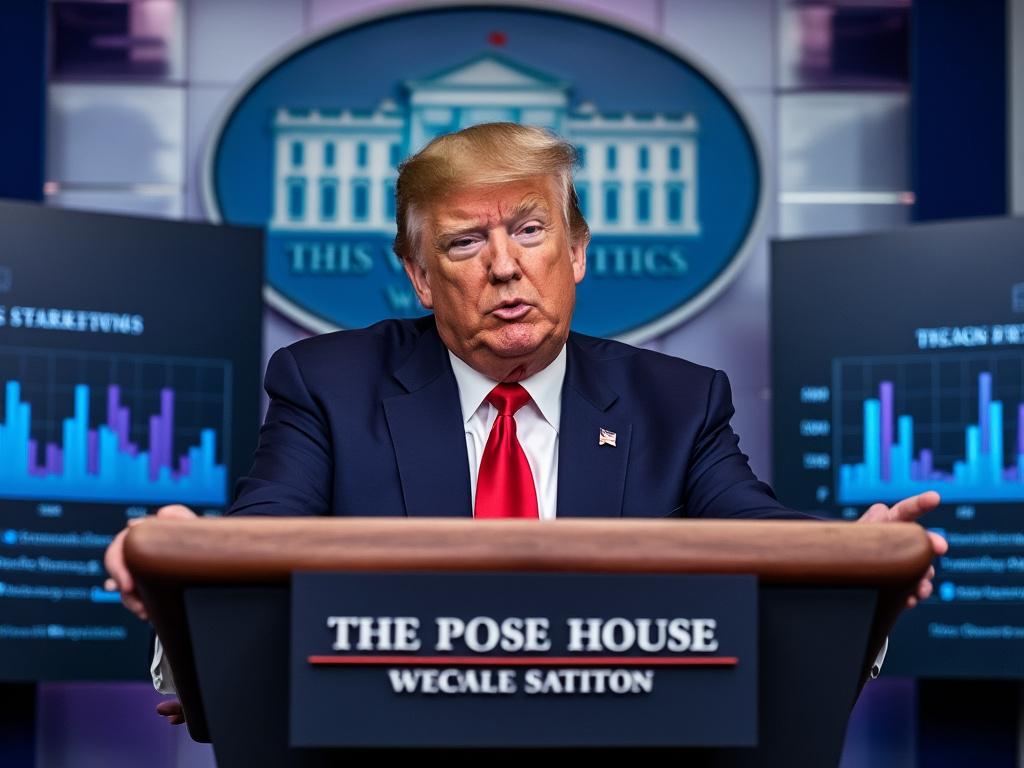
In early August 2025, President Trump’s dismissal of Bureau of Labor Statistics Commissioner Erika McEntarfer following a controversial jobs report ignited debates over the integrity of federal statistics and the influence of political maneuvering on empirical data.
Events Leading to the Firing
The job report of July 2025, identified as a pivotal trigger for these unprecedented actions, brought immediate firestorm on social media, primarily initiated by President Trump himself. Labeling the statistics as “fabricated” and “harmful to the public trust,” his swift condemnation did not merely challenge the BLS’s credibility but intensified a broader conversation about governmental transparency. National stakeholders, ranging from economic analysts to corporate leaders, were polarized—some echoing the President’s distrust, while others defended the integrity of the BLS data, underscoring the agency’s long-standing reputation for objectivity and reliability. This explosive mix of political, social, and economic reactions set the stage for the administration’s drastic response in the following weeks.
Administration’s Justification
In defending the decision to terminate Commissioner McEntarfer, President Trump and Kevin Hassett, Director of the National Economic Council, asserted a dire need for more “accurate” and “transparent” labor statistics. They accused the BLS under McEntarfer’s leadership of persistently “massaging” data to paint a more favorable economic portrait, which they claimed misled policymakers and the public alike. This narrative was strategically framed around the principle that reliable and truthful data are paramount for effective governance. Although specific instances of alleged data manipulation were not substantiated in detail, the administration leveraged these serious accusations to justify their dramatic step, intensifying debates about the integrity of federal statistical systems and governmental interference.
Response from BLS Leadership and Former Commissioners
In light of President Trump’s decision to fire BLS Commissioner Erika McEntarfer, former Commissioner William Beach and other past leaders quickly voiced their concerns. They strongly defended the Bureau’s methodologies, asserting the independence and reliability of their statistical processes. They firmly rebuked accusations of data rigging, emphasizing that these claims were unsubstantiated and potentially damaging. Their primary worry was the severe impact this dismissal could have on public trust, considering the importance of nonpartisan, accurate federal statistics for policy-making and economic forecasting. Their statements were intended to reassure the public and stakeholders about the continuing integrity within the Bureau, especially vital in maintaining the credibility that underpins effective government and economic planning.
Operational Realities and Safeguards
The Bureau of Labor Statistics (BLS) upholds stringent statistical methodology underpinned by rigorous internal checks to safeguard the accuracy and reliability of its data. These include anonymization of raw data, extensive validation through cross-referencing with other datasets, and methodological consistency checks before publication. Despite concerns about leadership changes, these foundational systems support the BLS’s resilience, ensuring continuity and data integrity. Routine operations, deeply embedded within the agency’s framework, maintain an equilibrium that is relatively impervious to sudden shifts in leadership, allowing the BLS to continue providing reliable data essential for policy-making and economic analysis.
Broader Implications
The firing of Erika McEntarfer as BLS Commissioner raises alarms about the ongoing struggle to retain nonpartisan control over federal statistical agencies. This dismissal risks the perceived neutrality of these bodies, thus potentially tarnishing the credibility of vital national data. The independence of such agencies is pivotal in fostering trust among the public and policymakers alike, ensuring that decisions at the highest levels are informed by facts, unaffected by political biases. The long-term implications may result in skepticism towards federal statistics, a concerning prospect that could undermine the foundation of policy debates and economic planning. Fluctuating leadership, influenced by political motives, could destabilize this trust, making it increasingly challenging to use this data to effectively govern and maintain public engagement.
Conclusions
The controversial firing of BLS Commissioner Erika McEntarfer by President Trump following an unfavorable jobs report has spotlighted the critical importance of preserving the independence and integrity of federal statistical agencies to ensure public trust and informed policy-making.