
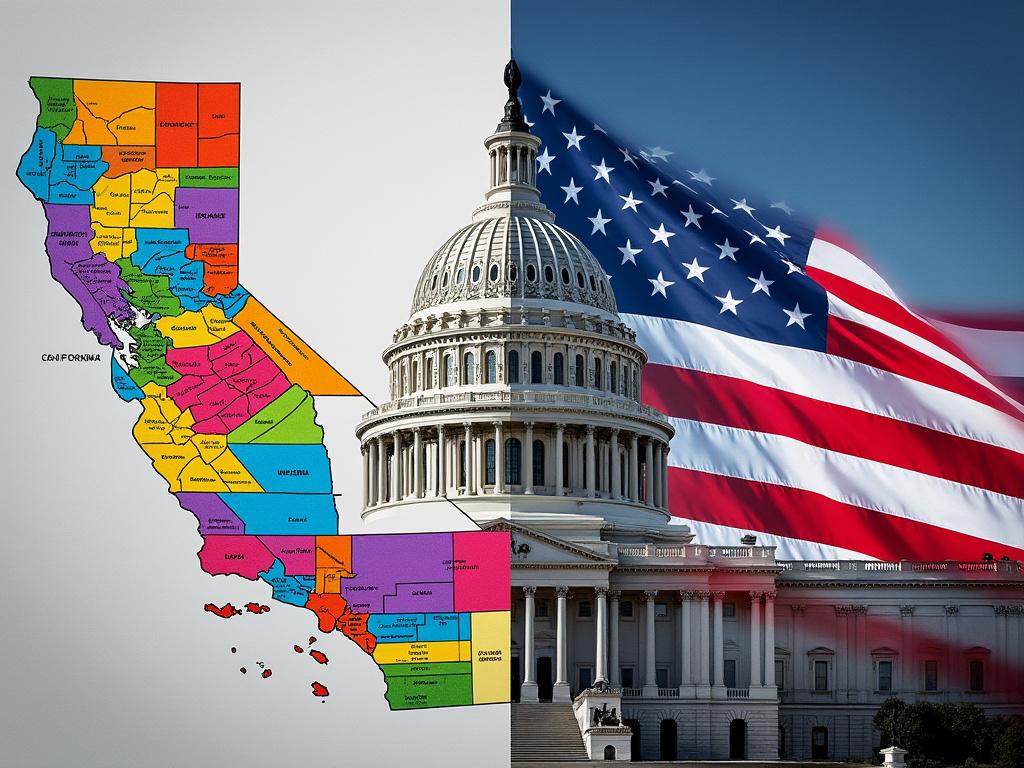
California Governor Gavin Newsom proposes a high-stakes redistricting plan in response to actions by Texas, igniting a debate on the future of political power distribution both in California and nationally.
Background Redistricting and California’s Process
In 2010, California pioneered a radical shift towards nonpartisan redistricting by establishing the California Citizens Redistricting Commission. This independent body was tasked with drawing electoral districts for the State Senate, Assembly, and U.S. Congress, a responsibility previously held by the state legislature. Its formation, driven by public demand for transparent governance, aimed to curb gerrymandering by ensuring districts are drawn without political or incumbent influence. The commission must adhere to strict, non-partisan criteria including contiguity, geographical integrity of local neighborhoods or communities, and compactness of districts, significantly realigning California’s approach to guarantee fair representation. Such structured impartiality is designed to reflect the state’s diverse population equitably, a model that challenges political manipulation prevalent in other states.
Newsom’s Proposal A Temporary Shift in Power
In a bold strategic maneuver mirroring actions by Republicans in Texas, Governor Gavin Newsom proposes temporarily suspending California’s independent redistricting commission. Favoring legislative control for map drawing, this shift entails holding a special election to validate the newly drawn districts. Planned swiftly to reinforce Democratic footholds, this tactical response introduces an expedited timeline, initially aligning with upcoming electoral cycles. These interim maps, subject to approval, strategically aim to counteract perceived Republican advantages in Texas and potentially recalibrate Congressional representation in favor of Democrats.
Motivations and Political Context
Governor Newsom’s redistricting plan is deeply entwined with the political landscape shaped by moves in states like Texas, where Republican leadership has aggressively pursued gerrymandering to secure electoral advantages. By suspending the independent redistricting commission, Newsom’s strategy appears to safeguard Democratic strongholds and ensure California’s substantial congressional delegation remains favorably blue. This maneuver is not merely local politicking but a response to a broader pattern where such redistricting battles could critically sway the balance in the U.S. House of Representatives. Essentially, Newsom positions California as a counterbalance to Republican-dominated redistricting efforts, emphasizing the high stakes of maintaining Democratic influence at a national level.
Debate, Legal Questions, and Criticism
Governor Newsom’s redistricting plan has ignited intense debate, rooted in concerns that it may bypass California’s voter-supported independent redistricting commission established to prevent partisan manipulation. Critics argue that this move undermines the integrity of democratic processes and fear it could set a dangerous precedent for legislative overreach in electoral matters. Legally, challenges are being mounted on grounds that the plan violates state constitutional mandates for impartial map drawing. Conversely, supporters defend the plan as a strategic countermeasure against similar Republican tactics in states like Texas, which they argue compromise fair representation. They insist that urgent actions are necessary to maintain balance and avoid political gerrymandering that might marginalize voters’ influence. This clash of perspectives continues to play out in the public sphere, forming a critical junction in California’s approach to electoral fairness and governance.
Logistics and Next Steps
Governor Newsom’s redistricting initiative will necessitate intricate logistical planning. Primarily, orchestrating a special election demands substantial financial investment, with estimates suggesting costs could climb into the millions, considering personnel, voting facilities, and public communication efforts. The California Legislature plays a pivotal role, tasked with drafting and approving the new district maps. Once created, these proposals must be transparently presented to the public, allowing ample time for review and feedback before voting. Governor Newsom’s administration has signaled forthcoming detailed announcements, which will further clarify timelines and procedures involved in this critical electoral process.
Conclusions
Governor Newsom’s redistricting plan marks a pivotal moment for redistricting practices, reflecting the intricacies of balancing democratic integrity with strategic political maneuvering. This plan not only shapes Californian politics but also holds implications for the national landscape, testing the resilience of bipartisan redistricting systems.