
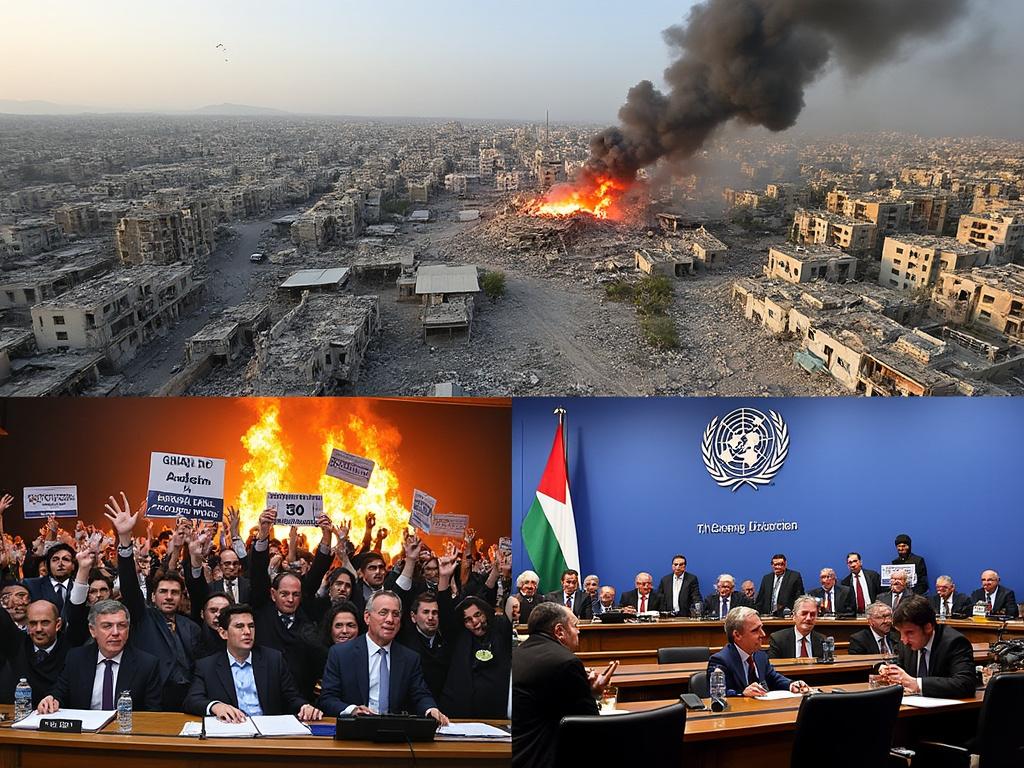
Israel’s proactive military pursuit to dismantle Hamas in Gaza since October 2023 has escalated into a full-scale conflict, raising critical questions about its strategic implications, humanitarian costs, and international fallout. This article examines the underpinnings, methodologies, and consequences of Israel’s contentious actions.
The War’s Origins and Strategic Goals
The onset of Israel’s military campaign against Hamas was catalyzed by Hamas’s attack on October 7, 2023, resulting in significant Israeli casualties and abductions. This chapter explores Israel’s rationale behind its decision for a relentless and comprehensive military strategy aimed at the total dismantlement of Hamas as a dual military and governmental entity in Gaza. It discusses the geopolitical and security imperatives that shaped Israel’s resolution to forsake negotiations for a military intervention, exploring the statement that Israel had to “comb through Gaza, inch by inch, in search of the hostages”.
Tactics and Humanitarian Crisis
Israel’s military campaign, notably characterized by intense aerial bombardments, rigorous ground incursions, and stringent blockades, has wreaked havoc on Gaza’s infrastructure and its civilian populace. The aerial strikes, aimed at Hamas targets, often fail to distinguish between militant and civilian structures, leading to widespread destruction of homes, schools, and hospitals. On the ground, troops confront not only armed combatants but also a distressed civilian population amidst the rubble of ongoing conflict, complicating the operational landscape.
The blockade, augmented significantly since the recent hostilities began, severely restricts the flow of essential commodities, including food and medical supplies, into Gaza. This has precipitated a humanitarian crisis of immense proportions, drawing sharp criticism from international bodies. The United Nations has repeatedly flagged these actions as potential violations of international humanitarian law, focusing on the principles of proportionality and distinction, fundamental tenets designed to protect civilian lives during armed conflicts.
The international backlash, increasingly vocal, underscores the grave diplomatic repercussions of Israel’s operational tactics in Gaza, setting the stage for intensified global scrutiny and calls for immediate cessation of hostilities. This mounting international pressure forms a precarious backdrop as Israel navigates its strategic objectives against Hamas amidst a deteriorating humanitarian situation and a collapsing global reputation.
Diplomatic Isolation and Reputational Decline
Israel’s vigorous campaign in Gaza, aimed at dismantling Hamas, has sparked significant diplomatic repercussions that extend beyond its immediate geopolitical sphere. In particular, actions perceived as disproportionate have led to the suspension of arms sales by key allies, a notable setback in Israel’s military engagements. Simultaneously, increased diplomatic censure has emerged from international bodies, further complicating its global standing. This strategic isolation is mirrored in grassroots movements where global public opinion has coalesced into protests and academic boycotts, signaling a deepening global disillusionment with Israel’s tactics. This trend reflects a broader recalibration of international relations, wherein Israel’s historical alignments are increasingly strained by its ongoing strategies in Gaza.
Strategic and Political Fallout
Despite tactical successes, Israel’s protracted military efforts have struggled to dent Hamas’s capabilities significantly, leaving strategic objectives unmet. The conflict has inadvertently emboldened Hamas, enhancing its standing as a symbol of resistance in Palestinian and broader Arab eyes. Meanwhile, the captivity of hostages by Hamas continues, a glaring failure in Israel’s mission and a persistent source of domestic and international criticism.
This scenario is further complicated by Israel’s actions contributing to a more hostile regional atmosphere. The continuous strikes in Gaza have indirectly strengthened Iran’s resolve and alliance with various militant groups, which could spell broader regional instability. This has led to a precarious situation where Israel finds itself confronting an increasingly unified front of adversaries, enhancing the likelihood of a larger regional conflict that could spiral beyond its control. Such developments starkly contrast the isolation discussed in previous segments and set the stage for further deterioration of Israel’s international standing, explored in subsequent chapters.
Long-Term Damage to Israel’s Standing
The persistent intensity of Israel’s military operations in Gaza, aimed at dismantling Hamas, has incited significant international criticism, casting a shadow over Israel’s global image. The narrative that once prominently featured Hamas’s aggressions is increasingly overshadowed by global perceptions of Israel’s actions as excessively harsh. Such perceptions are catalyzed by images and reports of civilian casualties and the humanitarian crisis in Gaza, which starkly contrast with the principles of proportionality and necessity in international law. This shift in global sentiment is not just a transient issue but a profound challenge, potentially isolating Israel diplomatically and softening support from its traditional allies. The repercussions extend beyond immediate strategic setbacks, pressing Israel to recalibrate its approach to not only military engagements but also its diplomatic strategies, striving for a balance that will safeguard its national security while also maintaining its international standing.
Conclusions
While Israel’s objectives in Gaza were clear, the extensive military campaign has not only failed to decisively end Hamas’s threat but also significantly tarnished Israel’s international reputation and standing. The strategic miscalculations have led to a paradox where the intense efforts to secure its population from terrorism have instead isolated Israel globally and intensified regional threats.