
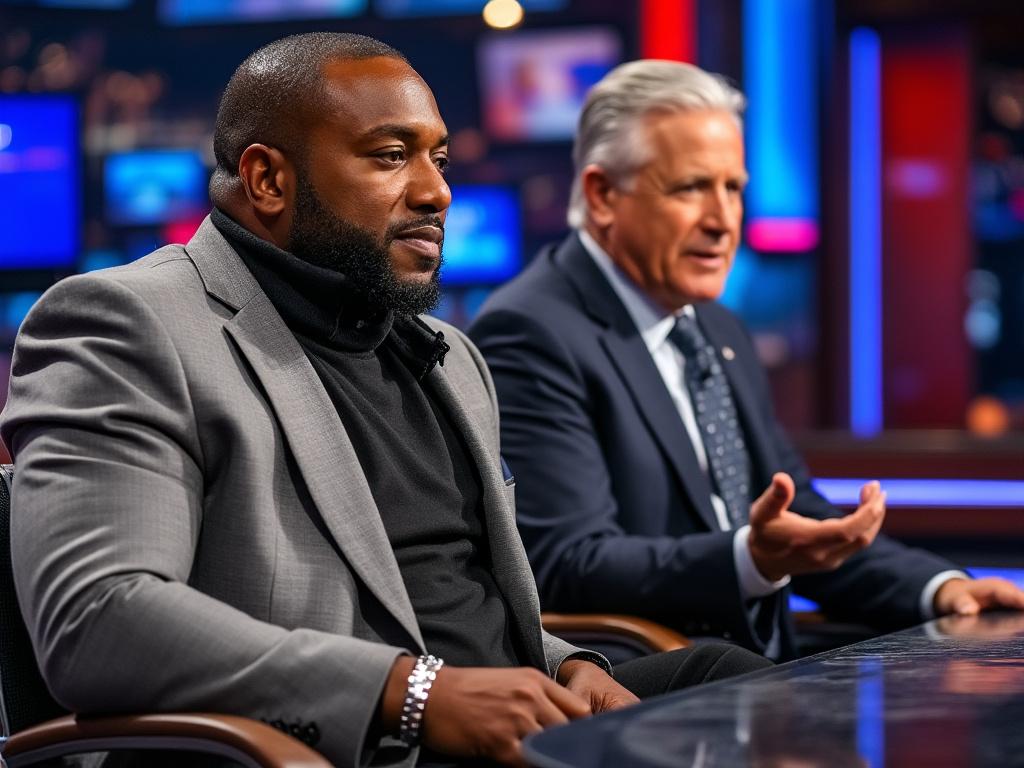
In a striking blend of entertainment and politics, Charlamagne tha God has proposed Jon Stewart for the 2028 U.S. presidential election. This public endorsement sparks discussions on potential shifts within the Democratic Party and the role of celebrity in political leadership.
The Provocative Proposal
In his controversial appearance on ‘My View with Lara Trump’, Charlamagne tha God advocated for Jon Stewart, a beloved media figure and political commentator, to run for the presidency in 2028. Charlamagne expressed that traditional political approaches have become obsolete, voicing a growing disconnect between current Democratic leaders and the electorate. He highlighted Stewart’s success in advocacy, notably in securing health benefits for 9/11 first responders, as evidence of the latter’s ability to effectuate significant legislative outcomes outside the typical political framework. His endorsement of Stewart underscores a desire for innovative leadership that steps away from conventional political paradigms and reinvigorates Democratic appeal through genuine, impactful activism.
Analyzing Charlamagne’s Critique of the Democratic Establishment
Charlamagne severely critiqued the Democratic establishment, voicing dissatisfaction particularly after Kamala Harris’s 2024 defeat. He pinpointed their inability to connect with the electorate’s evolving demands and a perceived stagnation in innovative policy-making. Charlamagne’s endorsement of Jon Stewart reflects his desire for transformative leadership destined to challenge conventional party strategies. By proposing Stewart, a seasoned media personality and activist, he highlights the urgency for the Democrats to embrace a dynamic and direct approach that can appeal to a broader, more diverse voter base. This move is seen as a path to injecting vitality and a clearer vision into the party’s future endeavors.
Jon Stewart’s Political and Social Impact
Jon Stewart, acclaimed former host of “The Daily Show,” has leveraged his platform for significant social and legislative advocacy, notably championing a 2022 law that expanded healthcare benefits for veterans exposed to toxic burn pits. His testimony before Congress was not only poignant but effective, highlighting his capacity for empathetic and informed leadership. Charlamagne tha God, recognizing these qualities, sees Stewart as a candidate who genuinely understands and addresses critical issues. This depth of involvement in pressing national concerns, coupled with his media savviness, validates Charlamagne’s view of Stewart as more than a celebrity but as a potential political leader capable of bridging divides and enacting meaningful change. Ultimately, Stewart’s transition from satire to serious advocacy underlines his unique potential in political spheres, intriguing supporters and onlookers alike.
The Stewart-Colbert Dynamic
Exploring Charlamagne tha God’s playful yet thought-provoking endorsement of a Jon Stewart-Stephen Colbert ticket unveils a fascinating discourse on the fusion of humor and serious political engagement. The dynamic between Stewart and Colbert, both heralded for their sharp wit and incisive political commentary, represents a unique potential to transform public discourse. With Stewart’s proven dedication to substantive issues and Colbert’s knack for satire that cuts to the core of political absurdities, their collaboration could serve as a bridge, engaging a wider demographic. This approach could notably alter the playing field, turning apathy into action and disenfranchisement into participation, emphasizing a shift toward candidates who are both intellectually engaging and genuinely entertaining. Their partnership highlights an evolving political landscape where charisma and knowledge blend seamlessly, setting a new precedent for non-traditional candidates in the realms of credibility and relatability.
The Broader Implications of Celebrity Political Involvement
The ascent of celebrities into political arenas, as demonstrated by Ronald Reagan and Donald Trump, underscores a shifting paradigm where media prominence can effectively translate into political power. These figures have leveraged their public familiarity and communication expertise to forge significant political careers, blending entertainment with serious policy-making. Jon Stewart’s potential candidacy is poised on similar credentials: a profound public reach and a honed acuity in addressing complex issues through a media lens. His sharp political wit, honed on *The Daily Show*, could be a critical asset in navigating the intricate landscapes of national politics. This hybrid vigor of media influence and genuine advocacy might not only redefine celebrity roles in politics but could also resonate with a populace increasingly disillusioned with traditional political figures.
Conclusions
Charlamagne tha God’s endorsement of Jon Stewart for a presidential run in 2028 transcends a simple political suggestion, reflecting widespread frustration with traditional political frameworks and yearning for innovative leadership. Whether Stewart steps into the political arena remains to be seen, but the dialogue underscores the evolving relationship between media figures and political power in America.