
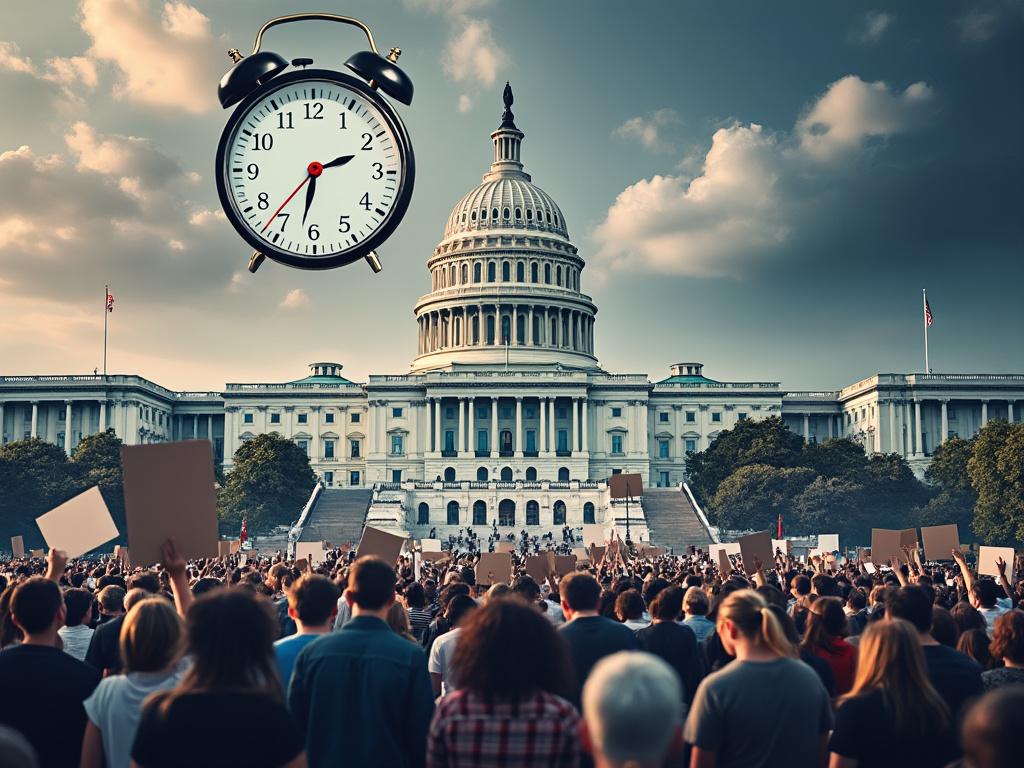
As the threat of a government shutdown intensifies, mounting tensions within the Republican Party reveal deep divisions over fiscal policy and strategy. This article explores the complex interplay between House and Senate Republicans, their diverging priorities, and the influence of former President Trump on these debates.
The Crumbling Consensus
As the deadline for federal funding draws near, a palpable division has surfaced within the Republican Party, deeply rooted in their strategic approach to the looming fiscal negotiations. The House Republicans, emboldened by a strong conservative faction, are pushing for aggressive expenditure reductions. Their aim is clear: substantial slashing of the federal budget to align with their stringent fiscal conservatism. In stark contrast, the Senate Republicans, navigating the nuanced political landscape, are opting for a more moderate path. They prioritize stability and the avoidance of a government shutdown, advocating for more measured cuts and cooperative dialogue with Democrats. This strategic schism underscores a broader ideological rift within the GOP, threatening the unity necessary to present a consolidated front in budget discussions. The disparity between the desires for deep cuts and pragmatic moderation could derail timely negotiations, setting the stage for a potential fiscal impasse.
The Battle Over Budget Priorities
As Congress gears up for the impending showdown over funding, a discernible rift within the GOP becomes evident through the lens of budget priorities. House Republicans, propelled by a more conservative base, have proposed substantial cuts across various federal programs, advocating for reductions particularly in areas like environmental regulation and social welfare, programs they argue are overextended or inefficiently managed. On the other side, Senate Republicans present more cautious cuts, reflecting a strategic approach aimed at sustaining functionality of key services while still acknowledging fiscal prudence.
This division not only underscores the ideological spectrum within the party but also hints at potential ramifications for federal operations. Significant cuts as envisioned by House factions could lead to diminished capacity in critical areas such as health research, education, and environmental protections. Such reductions may accelerate short-term fiscal consolidation but could pose long-term risks to public welfare and systemic stability, echoing tensions between immediate fiscal restraints and sustainable governance.
Strategic Moves and Stalemates
In the labyrinthine corridors of Congress, the GOP leadership proposed a strategic yet divisive maneuver: a year-long continuing resolution to sustain government funding at current levels. This move aimed to avert immediate fiscal disruptions but sparked considerable dissent within their ranks. Hard-right factions saw this as a capitulation, a failure to leverage the budget process to shrink government size effectively. They demanded more aggressive cuts and reforms instead of a mere extension of the status quo.
Contrastingly, Democrats criticized the resolution as a blunt instrument that neglects necessary budgetary enhancements in key areas like healthcare and education, stymying necessary fiscal progress. The implications of adopting such a stopgap measure are profound, threatening to perpetuate funding inadequacies and forestalling essential reforms. This deadlock not only underscores the fiscal policy challenges but also reveals deep fissures in governmental operational philosophies, setting the stage for heightened partisan standoff as the potential shutdown looms.
The Quest for Regular Order
The Republican pledge to reestablish regular order in the appropriations process is integral to their strategy, aiming to individually pass the twelve annual spending bills required by law—an achievement not seen since 1996. However, this promise clashes starkly with the prevailing partisan gridlock and the escalating demands from multiple GOP factions, each with divergent fiscal priorities. The rift within the party complicates adherence to regular order, mirroring the broader legislative paralysis. Failure to reestablish this order undermines the predictability and stability necessary for effective governance, potentially leading to hasty, last-minute funding measures. This discord sets the stage for the Democrats to exploit GOP divisions, as they aim to thwart regressive policies and ensure the continuity of their spending agendas.
Democrats’ Strategic Counter
As the GOP struggles with internal divisions and aims to restore regular order, Democrats see an opportunity to push their agenda by exploiting these rifts. They strategically promote bipartisanship in budget negotiations, particularly to block Trump-era policies detrimental to their priorities. Essential to this approach is their effort to engage moderate Republicans who are disillusioned with the extreme wings of their party. This strategy not only helps preserve Democratic spending priorities but also affects fiscal policy dynamics broadly. The threat of a government shutdown becomes a pivotal moment where Democrats can present themselves as the more stable and responsible governing alternative, potentially swaying public opinion and gaining leverage in policy negotiations.
Conclusions
As Republicans grapple with internal divisions and strategic disagreements, the likelihood of a government shutdown grows. The outcome of this political tug-of-war will significantly impact federal operations and the lives of millions of Americans. Balancing fiscal conservatism with practical governance remains a critical challenge for the GOP.