
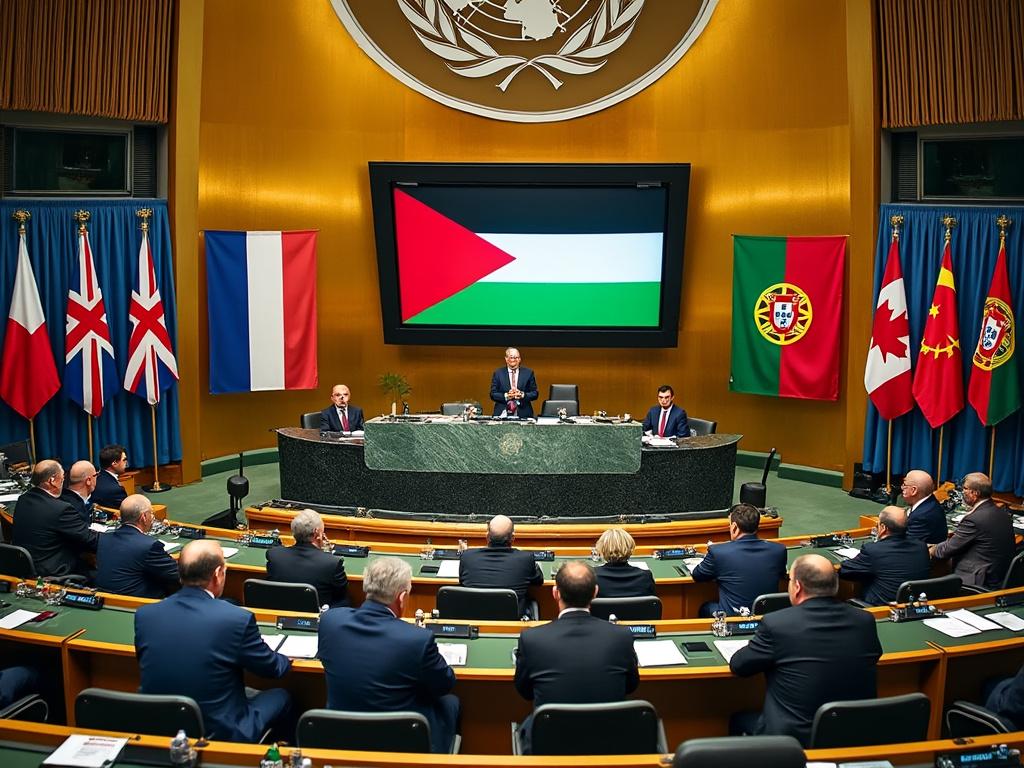
In September 2025, a significant diplomatic shift is expected at the United Nations General Assembly as France, the United Kingdom, and a coalition of Western nations move toward formally recognizing the State of Palestine. This article delves into the motives, implications, and challenges of this landmark decision.
Background: Why Now?
Currently, the sudden urgency from Western nations, particularly France and the UK, to recognize Palestinian statehood stems from recent escalations in regional tensions. For years, the recurrent wars in Gaza have portrayed the fragility of the peace process, but the dramatically accelerated Israeli settlement activities in the West Bank have ignited new international concerns. These settlements are widely regarded as a chief obstacle to the feasibility of a future Palestinian state, pushing the territories towards what many European leaders see as a “mortal danger” to the two-state solution. Statements from French and British officials underline a consensus that without immediate intervention, the prospect for a lasting peace that includes a sovereign Palestinian state might be irreparably compromised. This strategic shift is not just a reaction to on-the-ground changes but also a preemptive move to forestall further erosion of stability in the region.
The Mechanics of Recognition
The Mechanics of Recognition: France, spearheading the initiative, aims to co-sponsor a resolution alongside Saudi Arabia. The proposal will outline a clear roadmap for the establishment of a Palestinian state. Fundamental elements include an immediate call for Israel’s withdrawal from Gaza and the disarmament of militant groups such as Hamas. By asserting these prerequisites, France and its allies anticipate paving the way for a sustainable two-state solution. This diplomatic shift operates under international law frameworks, specifically resonating with past UN resolutions regarding self-determination and state sovereignty. Each step, meticulously articulated during these diplomatic engagements, involves intensive negotiations aiming to reconcile the complex political realities with the envisaged peaceful coexistence of Israel and a future Palestinian state.
Political and Geopolitical Implications
The Western move towards recognizing Palestinian statehood could profoundly reshape both the Israeli internal political scene and the broader geopolitical landscape. In Israel, this emerging recognition might confront Prime Minister Netanyahu’s government with heightened diplomatic isolation, pressuring a reevaluation of policies towards Palestine and settlements. This shift could potentially strain the right-leaning coalition, pushing for a more moderate stance or risking political instability.
Globally, recognizing Palestine enhances its legitimacy, encouraging more nations to engage diplomatically with the Palestinian Authority. This could shift how peace processes are mediated, traditionally dominated by U.S. involvement. The expansion of European influence in these proceedings might encourage a more multilateral approach to Middle East peace, possibly diminishing unilateral U.S. hegemony in the region. This strategic shift hints at a more balanced international platform where Palestinian interests could be more substantially represented and acknowledged.
Domestic and Symbolic Dimensions
In France and the UK, the move to recognize Palestinian statehood mirrors a significant public sentiment that favors a more balanced approach to the Israeli-Palestinian conflict. Public opinion surveys consistently reveal a substantial portion of the populations within these countries support Palestinian sovereignty. This domestic backdrop acts as a catalyst for leaders like President Macron, who positions France as a champion of human rights, to advocate for recognition, thereby aligning foreign policy with public sentiment and his presidential legacy. The decision also serves broader political purposes, potentially stabilizing coalition governments or appeasing factions that favor pro-Palestinian policies.
Simultaneously, these recognition efforts by Western nations symbolically amplify the Palestinian quest for statehood. By officially acknowledging Palestine, nations like the UK and France can influence other countries to follow suit, thereby increasing the global visibility and legitimacy of the Palestinian state. This can have a profound impact on international diplomacy, reshaping how nations worldwide engage with the Israeli-Palestinian conflict, and potentially leading to broader international acknowledgment and support for the Palestinian cause.
Obstacles and Skepticism
The initiative to recognize Palestinian statehood by countries like France and the UK introduces a complex dynamic fraught with regional and international obstacles. Internally, the Palestinian political landscape is sharply divided between the Palestinian Authority in the West Bank and Hamas in Gaza, a split that complicates the establishment of a unified governmental front necessary for effective statehood. Externally, Israel’s staunch opposition remains one of the most significant hurdles. Any movement towards recognition could escalate tensions, influencing Israel’s security policies and its relations with recognizing nations. Moreover, the effectiveness of recognition is dubious without substantial changes on the ground. The creation of an internationally recognized state is more symbolic than practical if it doesn’t lead to improved governance and living conditions for Palestinians. Thus, the success of this initiative hinges not only on the diplomatic recognition but also on substantial support for reconciliation within Palestinian factions and constructive engagement with Israel.
Conclusions
The intention of France, the UK, and their allies to recognize Palestine represents a pivotal recalibration in international diplomacy concerning the Israeli-Palestinian conflict. While symbolically strong and potentially transformative, the ultimate success of this initiative hinges on the resolution of deep-seated political challenges and the effective mobilization of global and regional support.