
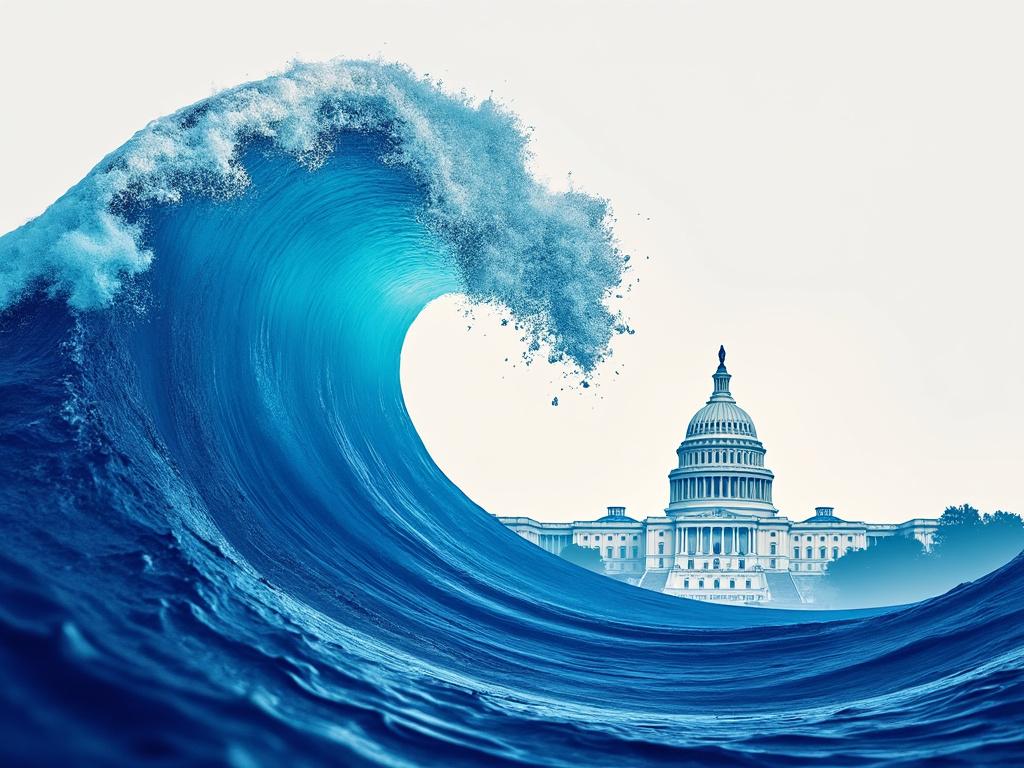
As the 2025 electoral cycle unfolds, the anticipated Democratic surge, popularly termed as the ‘blue wave,’ appears to be far less pronounced. This article delves into the current political landscape, exploring why the expected Democratic dominance is emerging more as a trickle than a tide.
Evaluating Early Election Indicators
The Democrats’ initial hopes for substantial electoral gains in the 2025 cycle seem to be waning as early indicators suggest a more timid shift. Pollster Matt Taglia coined the term ‘blue trickle,’ reflecting the modest changes in voter sentiment and turnout expectations. Polling trends reveal a noticeable dip in the enthusiasm that was originally projected. Challenges in campaigning strategies and structural limitations are further complicating efforts. The driving factors include a somewhat disenchanted base coupled with an effective counter-strategizing by opponents who are capitalizing on current socio-economic issues. This tempering of expectations is now leading the party to recalibrate its approach, focusing more on maintaining their existing strongholds rather than expansive gains.
Federal and State Dynamics
Forecasting models suggest the likelihood of Democratic gains in the upcoming elections, yet actual outcomes remain uncertain. The Center for Politics highlights that while some Senate races appear to align with presidential voting trends, the reality of voter behavior in battleground states is elusive. Similarly, insights from the National Conference of State Legislatures indicate state races are influenced by factors unique to their regional political landscapes. These complexities challenge the straightforward predictions of a ‘blue wave’ and underscore the nuanced nature of voter alignment and sentiment across different levels of governance. These forecasts juxtapose predictions with oft-unpredictable electoral responses, illustrating a pattern of discrepancy between expected and actual political shifts.
Barriers to a Democratic Surge
Various factors contribute to the dampening of a Democratic wave. First, increased polarization across the political landscape has intensified voter loyalty to party lines, reducing the number of persuadable swing voters. Additionally, strategic challenges such as redistricting have placed Democrats at a disadvantage in several key states, solidifying Republican strongholds and minimizing competitive districts. Furthermore, fundraising discrepancies have arisen, with several Democratic candidates struggling to match the financial resources of their Republican counterparts. Internal party conflicts, particularly between the progressive and moderate wings, have further fragmented Democratic unity, weakening their appeal to a broad electorate. These elements together shape voter perceptions negatively and degrade the competitiveness of Democrats in critical battleground states, impeding the expected ‘blue wave.’
Myth Versus Reality: Reevaluating the Wave
In assessing the expectations of a Democratic ‘blue wave,’ it’s essential to inspect the interplay of current political climates with historical precedents. The notion of a wave election, frequently portrayed as a large shift in Congressional power favoring one party, requires nuance and a contextual understanding. Scholarly analysis reveals that local issues and the caliber of candidates can be more decisive than national sentiment. For instance, research indicates that effective constituent service and alignment with local values may buffer incumbents against national waves. Moreover, as political landscapes evolve, the traditional metrics and narratives of wave elections must be recalibrated. Historically, waves are often recognized in hindsight, yet contemporaneous factors—like a district’s economic conditions or a candidate’s responsiveness to constituency needs—play critical roles. By revisiting these dimensions, it’s evident that what might initially seem like a wave in making could materialize more modestly, appearing rather as a trickle constrained by a complex interplay of factors. This understanding is crucial as the Democrats gear up for tactical adjustments in their approach to the upcoming elections.
Strategic Adjustments and Forward-Looking Approaches
Reflecting on the dampened enthusiasm for a “blue wave,” strategic recalibration emerges as essential for the Democratic Party. It is imperative to embrace a data-driven approach focused on competitive areas with tailored messaging that resonates with localized concerns. Surgically deploying resources, particularly in battleground states where the margins are slender, can transform prospects. Furthermore, reinvigorating grassroots movements through enhanced digital and door-to-door campaigns will engage disillusioned voters. Emphasizing candidate diversity to reflect the electorate’s breadth could also rekindle voter connection and bolster turnout. Adapting these strategies aligns with evolving voter demographics and issues, positioning the party to maximize its electoral representation diligently. The strategic foresight outlined here underscores the practical adjustments necessary for the Democrats to consolidate gains in the face of political realities.
Conclusions
The hope for a sweeping Democratic ‘blue wave’ in the upcoming elections confronts a harsh political reality, with the actual gains likely to be incremental. This necessitates a strategic realignment and tempered expectations among Democratic strategists and voters, aiming for feasible victories rather than overwhelming dominance.