
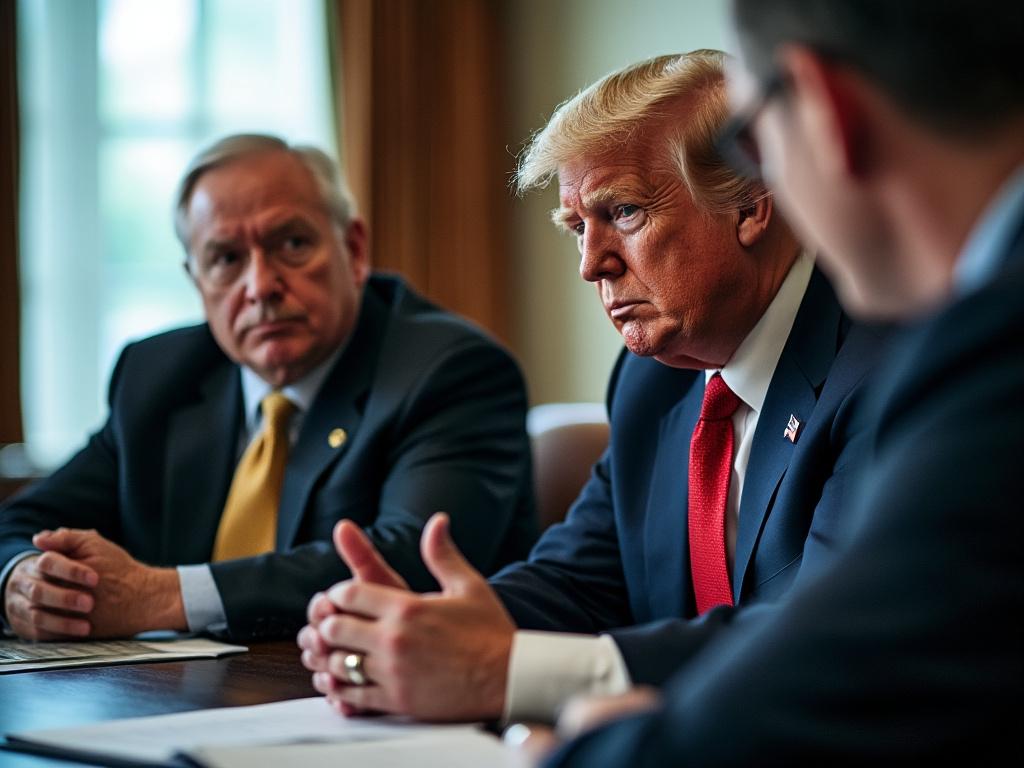
Amid recurrent tensions, President Donald Trump suggests he will likely not remove Federal Reserve Chairman Jerome Powell from office. This development marks a significant tone in their historically contentious interaction over U.S. monetary policies.
The Trump-Powell Relationship
The relationship between President Donald Trump and Federal Reserve Chairman Jerome Powell was marked by a complex interplay of public criticism and private expectations. Initially appointed by Trump, Powell later faced rebuke from the President for not aligning closely with the White House’s economic desires, particularly regarding interest rates. Trump publicly lamented Powell’s decisions, believing a more aggressive rate-cutting strategy was necessary to bolster the economy. Despite these pressures, Powell maintained a stance characterized by cautious monetary policies, prioritizing data-dependency over political influence. These divergent views led to numerous tense moments, with Trump expressing dissatisfaction through tweets and interviews, while Powell defended the independence of the Federal Reserve, emphasizing the long-term economic health over short-term gains. These interactions reveal a fundamental tension in the pursuit of economic stability amidst differing economic philosophies and priorities.
A Flashpoint in Monetary Policy
While President Trump vocally demanded significant rate cuts to stimulate growth, Chairman Jerome Powell and the Federal Open Market Committee (FOMC) maintained a cautious approach, opting to keep interest rates steady within a specific range. This decision was heavily influenced by mixed economic indicators: robust employment figures contrasted with subdued inflation rates. The FOMC’s stance was rooted in a commitment to data-dependency, aiming to avert potential overheating of the economy. Trump’s dissatisfaction was publicly aired, often taking to Twitter to criticize the Fed’s decisions, which he perceived as hindrances to economic expansion and improvements in the stock market. This ongoing tension underscored a stark divergence in economic policies, with Powell emphasizing long-term stability over short-term gains.
New Opportunity for Trump
The unexpected early resignation of Governor Adriana Kugler from the Federal Reserve Board presents a notable turning point in the strained dynamics between the Federal Reserve and President Trump. This vacancy offers Trump an unprecedented chance to appoint a successor who could champion his economic ideologies more fervently within the Federal Reserve. By nominating a candidate aligned with his perspective, Trump could decisively tip the balance of power in the Federal Open Market Committee (FOMC). This shift may engender a more accommodating monetary policy stance that better aligns with his administration’s goals, such as more aggressive interest rate cuts, which he had vociferously advocated for. This appointment thus stands not only as a strategic insertion of influence but also as a potential counterbalance to the prevailing currents within the FOMC that previously supported Powell’s more conservative approach. The consequences of this move are set against a backdrop of ongoing internal dissension and could redefine the future trajectory of U.S. monetary policy.
Internal Dissension at the Fed
As tensions within the Federal Reserve mounted, the dissent at Federal Open Market Committee (FOMC) meetings, particularly from Trump appointees, starkly highlighted the internal conflicts. The appointees often opposed the consensus reached by the committee, advocating for alternative monetary strategies that they believed would better align with the administration’s economic agenda. These divisions are not merely procedural; they signify deeper ideological splits that could profoundly influence the Fed’s future policy decisions under Powell’s leadership. The persistent opposition undermines Powell’s attempts to project a united stance on monetary policy, thus potentially complicating the execution of consistent monetary policy. Additionally, this ongoing discord within the FOMC might embolden further administrative attempts to influence Fed operations, further challenging the central bank’s prized independence in a way that could resonate through financial markets.
Political and Historical Context
The legal framework surrounding the Federal Reserve’s operation significantly constrains a U.S. President’s influence over the Fed Chair, rooted deeply in the principle of central bank independence established to shield monetary policy from political sway. Historically, while a president cannot directly dismiss the Fed Chair, significant pressure can be applied through public commentary or indirect means. President Trump’s fluctuating stance on Chair Powell’s tenure reflected such tensions. His public admission that he “most likely” won’t remove Powell eased imminent market anxiety but still left investors wary about potential future pressures. This statement post-dissent within the Fed underscores a complex balancing act: attempting to assert control without destabilizing financial markets or violating the Fed’s insulated status, pivotal for economic continuity and investment stability.
Conclusions
Despite fierce confrontations and criticisms directed at Jerome Powell, President Trump now indicates a shift towards maintaining stability at the Federal Reserve’s helm. This move reflects a strategic calculus aimed at influencing monetary policy indirectly, potentially shaping economic management as Powell’s term nears its end in 2026.