
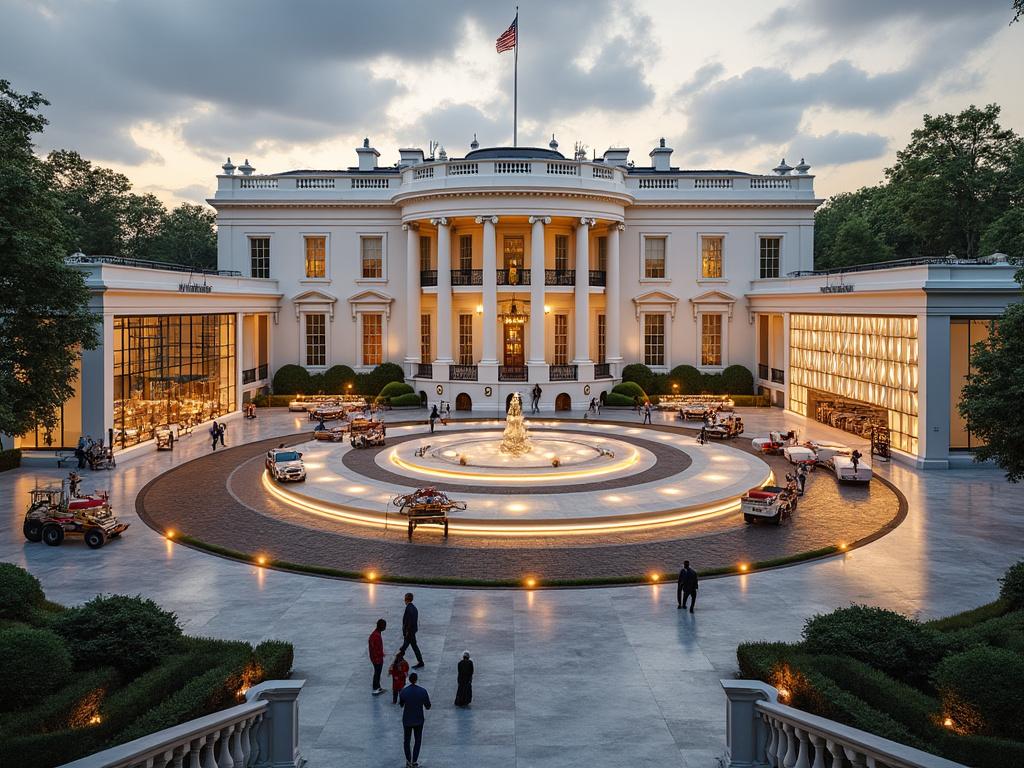
President Trump’s recent proposal to construct a sprawling $200 million, 90,000-square-foot ballroom at the White House has set off a vivid debate. This ambitious undertaking aims not only to augment the White House’s hosting capabilities but also raises questions about its necessity and impact on national heritage.
Unveiling the Grand Design
The announcement of President Trump’s plan for a grand White House ballroom has elicited strong reactions, particularly among his detractors. Critics argue the project exhibits an extravagant misuse of the presidential office for aesthetic enhancements rather than addressing critical national issues. Concerns center on potential ethical conflicts, with detractors questioning the transparency of funding and the involvement of private donors who might seek favor in policy decisions. Additionally, there is apprehension about the preservation of the historic integrity of the White House, a symbol of the nation’s heritage and democracy. Outraged voices stress that while the ballroom does not utilize taxpayer money directly, the use of presidential power to champion such grandeur could be seen as a departure from presidential norms focused on public service and governance.
A Legacy in the Making
President Trump’s envisioning of the White House ballroom as a “legacy-defining move” not only aims to augment the architectural grandeur but also asserts a cultural impact on the nation’s capital. Personal involvement is discernable as he guarantees that no taxpayer resources will be allocated to the construction, leaning instead on private donations. His portrayal of the project as a gift to the nation stirs a blend of admiration and skepticism among observers. How Trump’s promise of private funding will be upheld remains under scrutiny, particularly concerning transparency and donor influence. The endeavor raises questions about its implications for future administrations, who might inherit both its benefits and its controversies. Critics argue that while the ballroom could indeed enhance state functions, its construction during times of broader societal need seems misaligned with the duty of public office. Such debates underscore the complex legacy Trump seeks to imprint.
Critiques and Counterpoints
The unveiling of President Trump’s $200 million White House ballroom plan was met with immediate backlash, illustrating a stark divide in public opinion and political reaction. Critics argue that the lavish expenditure is ill-timed, especially when juxtaposed against broader, more pressing socioeconomic challenges such as healthcare and education reform. Political analysts express concerns about the priorities it reflects, suggesting that such an opulent project during times of national hardship may portray a disconnect between government actions and public needs.
Moreover, opposition parties seized the moment to question the ethical implications of accepting large private donations for such a project, emphasizing potential conflicts of interest and lack of transparency. These donations, critics argue, could bind the administration to the interests of a wealthy few, thus compromising the impartiality expected in democratic governance.
Preservationists also express unease, fearing that the addition of a modern, grandiose structure could undermine the historical integrity of the White House, a symbol of national heritage. They contend that existing spaces within the White House could be upgraded or repurposed more discreetly and at a lower cost, preserving the site’s historical essence while still achieving functional improvements.
Historical Context and Preservation Concerns
The proposal for a $200 million White House ballroom by President Trump has elicited significant concern from historians and architectural experts, who fear that such a modern addition could irreversibly alter the historic fabric of America’s most iconic residence. These experts argue that the White House, with its storied past and symbolic architecture, represents more than just a residence or venue; it embodies the nation’s continuity and democratic values. Historically, alterations such as the Truman Balcony and the Kennedy Rose Garden respected the original architectural ethos by blending new structures discreetly into the existing framework. Critics of the current plan claim that a lavish, large-scale ballroom could overpower these subtler, yet historically significant elements, possibly overwhelming the White House’s classic aesthetic with a modern, grandiose style that may not align with its centuries-old heritage. This fear underscores a broader debate on preserving the integrity of such a historically and politically significant site while allowing it to serve contemporary needs.
Strategizing for the Future
In strategizing for the future, President Trump’s vision for a new White House ballroom extends beyond mere aesthetics to embrace functional modernity. This initiative is aimed at creating a state-of-the-art venue, capable of accommodating larger, more sophisticated diplomatic and national events that the current facilities struggle to host efficiently. Intended as a versatile space, the proposed ballroom would not only enhance the White House’s capacity for high-profile gatherings but also solidify its stature as a global diplomatic hub. This foresight aligns with the administration’s broader agenda to modernize and optimize the property, ensuring its relevance and functionality for future administrations. The enduring utility envisioned encompasses an adaptable venue that could serve various state functions, from grand diplomatic receptions to significant public addresses, indicating a legacy of enhanced national prestige and operational capacity.
Conclusions
The proposed $200 million, 90,000-square-foot ballroom at the White House is a bold endeavor by President Trump, promising architectural grandeur and advanced functional capacities. However, it also faces significant scrutiny regarding its necessity and potential cultural impact. As debated, this ambitious project could either be seen as a visionary modernization or an extravagant misstep, reflecting the complex web of presidential legacy, national heritage, and public stewardship.