
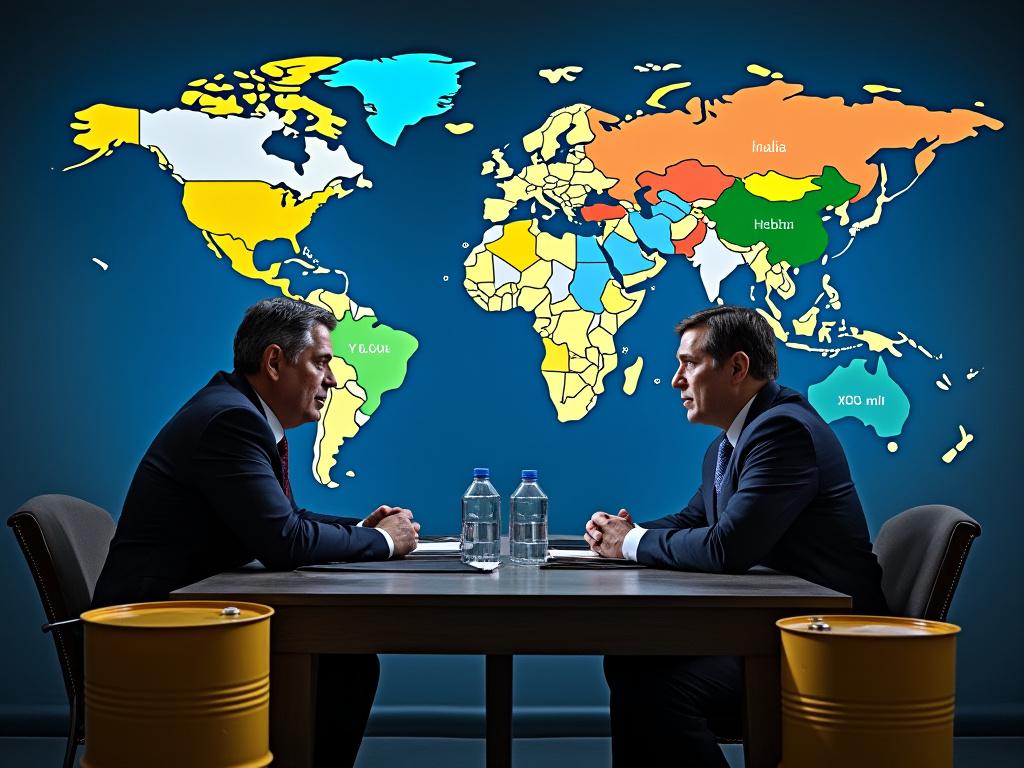
Amidst ancient strings and geopolitical tensions, the U.S. has threatened to increase tariffs on Indian exports in response to India’s continued oil trade with Russia.
Trigger of the Diplomatic Spat
On August 5, 2025, former U.S. President Donald Trump threatened to introduce substantial tariffs on Indian imports, framing this as a punitive measure against India’s continuous acquisition of Russian oil. Asserting that India was capitalizing on the ongoing Ukrainian crisis, Trump revived his familiar policy approach of leveraging tariffs for political purposes. This seasoned method, reminiscent of his earlier presidency term’s stance toward India on trade imbalances, once again strained the U.S.-India relations, already tenuous from past negotiations. This move starkly contrasted with the preceding cooperative phase, suggesting a regression in diplomatic progress between the two nations.
India’s Stand on Sovereignty and Economic Decisions
In response to the tariff threats pronounced by former President Trump, India’s Ministry of External Affairs issued a firm rebuttal, steadfastly defending its decision to import oil from Russia. The Ministry clarified that these purchases were driven by market conditions rather than political allegiances. By underscoring that India’s energy decisions were guided by economic pragmatism, not geopolitical inclinations, the statement emphasized India’s sovereignty in maintaining its fiscal stability and securing energy resources. Furthermore, the Ministry pointed out that economic interactions should not be misconstrued as endorsements of political ideologies or actions, asserting the nation’s right to safeguard its economic interests even amidst international disapproval. This stance highlighted a clear demarcation between India’s economic strategies and perceived political alliances.
Economic Repercussions and Domestic Challenges
In the shadow of Trump’s tariff threats, economic analysts predict severe repercussions for India’s trade balance with the U.S., projecting a stark decline in exports, especially in sectors heavily reliant on American markets like textiles and jewelry. The reaction within India was palpable in the volatility of Indian stock markets, which saw significant drops as investors fretted over the potential economic instability. Domestically, the political narrative intensified, with opposition parties vociferously criticizing the government’s stance. They argued that the acceptance of such external pressures not only undermined India’s national dignity but also jeopardized its economic autonomy. Such discourse reflected a broader concern about maintaining economic sovereignty while balancing international relations, particularly with such a vital partner as the United States.
Global Support and International Criticism
In the wake of U.S. tariff threats over India’s purchase of Russian oil, Russia vocally supported India, emphasizing the sovereignty of nations in making their own trade decisions. The Kremlin highlighted that such economic relations are legitimate under international law, and no other nation should impede sovereign trade choices. This stance starkly contrasts with international figures like Nikki Haley, who criticized the U.S. for its inconsistent policy, particularly pointing out the different approaches taken with India compared to China. Haley argued that such disparities could undermine international confidence in the principles of sovereign economic choice, a cornerstone of global commerce and diplomacy. This juxtaposition underscores a rift in international relations, where support and criticism of U.S. policies are both prominently displayed, challenging the fabric of global economic interactions.
Broader Implications for Global Diplomacy and Trade
The U.S.-India tariff dispute over Russian oil imports poses consequential diplomatic and trade implications that could reverberate through global alliances. Historically, the U.S. and India have cultivated a strategic partnership pivotal for regional security and mutual defense interests, especially as a counterbalance to China’s regional aspirations. However, the tariff threats may strain these ties, potentially causing India to reconsider its strategic alignments. This tension could encourage India to strengthen relationships with other major powers like Russia, who support India’s sovereign right to trade. Additionally, the dispute could prompt a shift in global trade alignments, influencing other nations’ trade decisions amid the ongoing Ukraine conflict. Consequently, the standoff not merely challenges bilateral relations but also impacts broader geopolitical dynamics and alliance structures.
Conclusions
The dispute between the U.S. and India over tariff threats linked to Russian oil purchases underscores the intricate dance of diplomacy, national interests, and global market dynamics. As part of their broader strategic autonomy, India seeks to navigate its economic demands and political pressures, reflecting the broader geopolitical complexities of today’s world.