
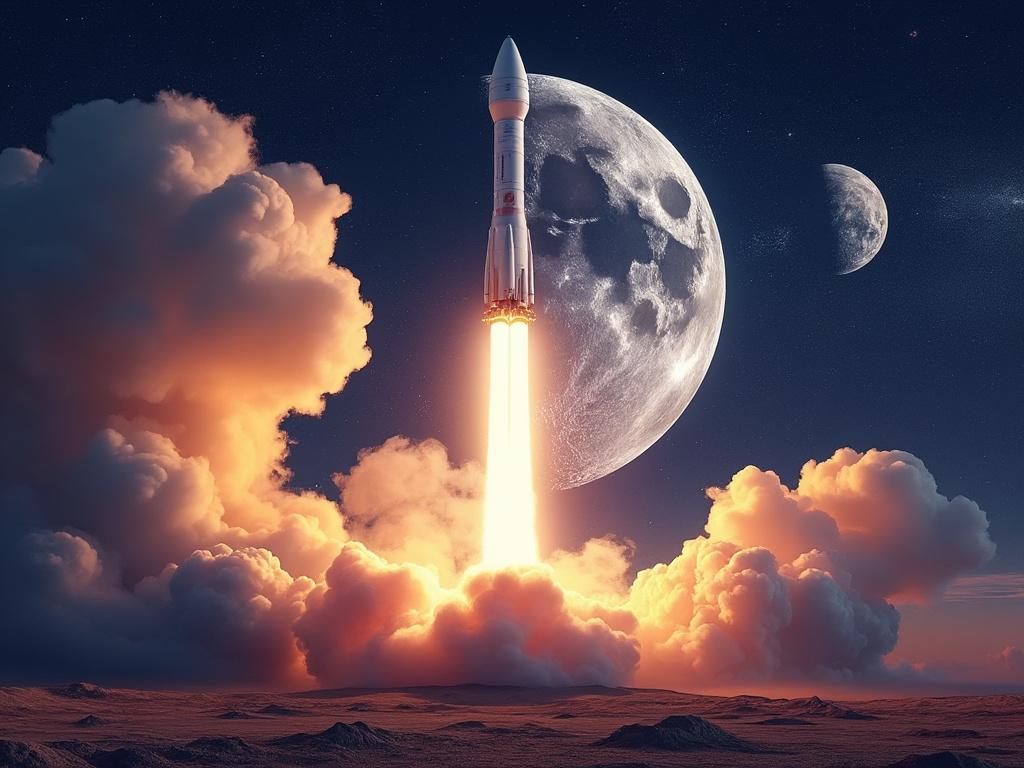
Amidst a historic resurgence in space exploration enthusiasm, about two-thirds of Americans currently support NASA’s initiatives to return to the Moon and aim for Mars. This article delves into the reasons behind the growing public support, the strategic advancements in space technology, and the anticipated future missions that promise to reshape our engagement with space.
Polling Data and Public Sentiment
Recent polling data suggests a significant shift in public sentiment towards space exploration, with robust support for lunar and Martian missions. This surge can be largely attributed to the broadcasted success of recent test flights and interplanetary rover landings, which have captivated the American imagination. Additionally, increased international competition in space has revitalized national pride, compelling many to support these space endeavors. Further, the promise of technological advancements and potential economic benefits derived from space resources and data have further bolstered public enthusiasm. This collective positivity reflects the growing belief that space missions contribute profoundly not only to scientific knowledge but also to societal progress.
The Artemis Program and Moon Missions
The Artemis program heralds a new era in lunar exploration, reintroducing human presence to the Moon while setting the stage for future Martian expeditions. Initiated with the uncrewed Artemis I in 2022, this ambitious endeavor will progress through Artemis II, the first crewed flight orbiting the Moon, to the historic landing of Artemis III. Planned for the mid-2020s, Artemis III aims to place the next man and the first woman on the lunar surface, emphasizing diversity and inclusion in space exploration. This program is not merely about revisiting the Moon but establishing a sustainable presence that facilitates deep space exploration. The technologies and experiences gleaned from these missions will form the foundation for the eventual human journey to Mars, highlighting NASA’s strategic forward-looking agenda. Each mission within the Artemis framework is designed as a building block, where learnings propel the next steps in humanity’s spacefaring narrative.
Commercial Partnerships and New Technologies
NASA’s push towards lunar exploration heavily relies on collaborations with commercial entities under initiatives like the Commercial Lunar Payload Services (CLPS). The CLPS has empowered companies such as Firefly Aerospace, which is developing its Blue Ghost lander, expecting to launch in 2024. This mission will carry ten scientific payloads to the lunar surface, providing essential data to further our understanding of the Moon’s resources. These partnerships not only enhance technological advancements but also help in sharing the financial burden and risks associated with space explorations. Importantly, technologies proven on the Moon will inform the systems needed for future Mars missions, thereby acting as crucial intermediaries for the longer voyages to the Red Planet.
Mars as the Ultimate Goal
While the Moon provides a vital training ground, **Mars** is the pinnacle of NASA’s ambitions. Building on technologies honed during lunar explorations—such as surface operations, life support systems, and in-situ resource utilization—NASA’s strategy for Mars is both progressive and pragmatic. Notably, the **Escapade mission** underscores an ongoing commitment to robotic Mars missions, serving as not only a technological precursor but also a scientific endeavor aimed at understanding Martian atmospherics and geology. This mission, together with the insights gained from lunar operations, forms a solid groundwork for the eventual manned Mars expedition. Such strategic steps are guided by a long-term vision that integrates immediate experiences with broader astronomical objectives.
Conclusion: Why Support is Surging
The surge in support for NASA’s return to the Moon and the voyage to Mars can be attributed to a potent mix of heightened public interest, political backing, and global competition. The rise of space-focused social media platforms and educational outreach has significantly boosted public enthusiasm. Politically, bipartisan agreements on the importance of sustaining American leadership in space technology have resulted in increased funding and congressional support for NASA’s missions. Furthermore, the emergence of international rivals in the space arena has ignited a renewed sense of urgency to pursue these extraterrestrial frontiers. This confluence of factors assures not only the continuation of the Artemis mission but also amplifies momentum towards Mars, aligning national pride with technological progress and exploration.
Conclusions
Amidst a wave of public and governmental support, NASA is poised for a transformative decade in space exploration. The Artemis program, fortified by both cutting-edge technology and international rivalry, rightly encapsulates America’s current ethos of not just returning to the Moon but also setting sights further onto Mars and beyond.