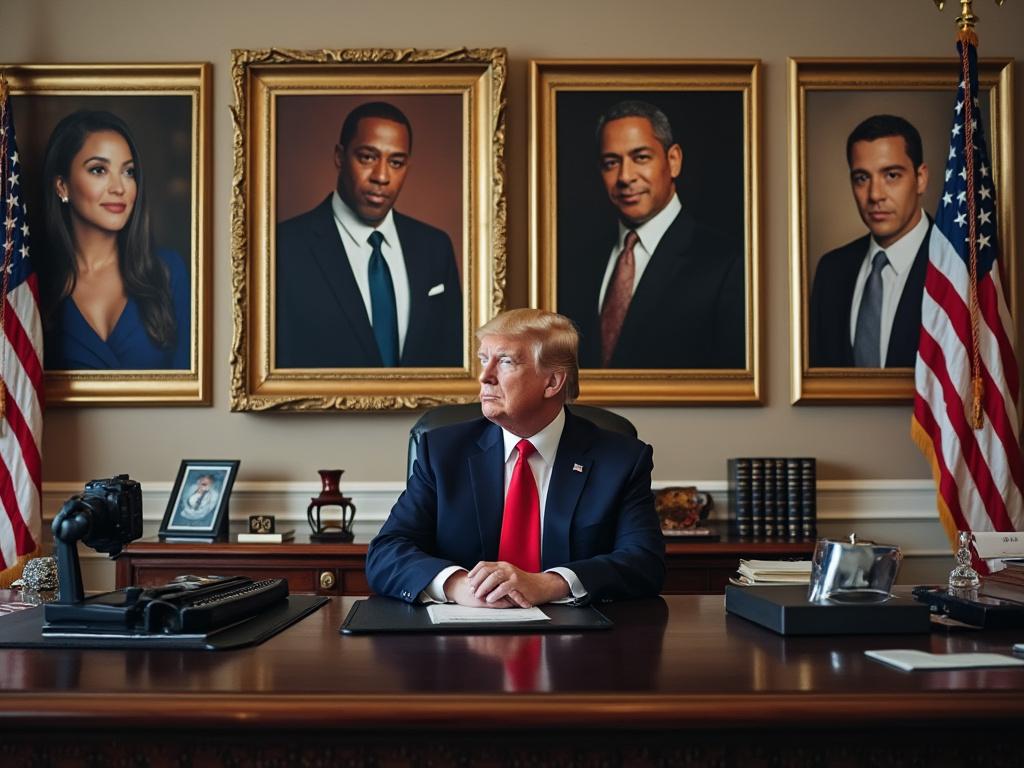
In a penetrating interview with Newsmax’s Rob Finnerty, former President Donald Trump revealed his current and most detailed perspectives regarding potential presidential pardons for Ghislaine Maxwell, Sean ‘Diddy’ Combs, and George Santos. These comments have sparked discussions about his political strategies and personal considerations.
The Case of Ghislaine Maxwell
In the labyrinth of Donald Trump’s presidential pardons, his denial of any intent to pardon Ghislaine Maxwell stands out starkly. Trump clarified that he had not received a request to pardon Maxwell, nor did he plan to initiate one. This decision, shedding light on the breadth of presidential discretion, also mirrors Trump’s cautious stance towards individuals embroiled in high-profile, controversial legal battles. By distancing from Maxwell, Trump aims to sidestep the potential political fallout and public outcry associated with her case, associated with sex trafficking charges linked to Jeffrey Epstein. This choice underscores a broader strategy of political and public image management, critical in maintaining his support base.
The Dilemma Concerning Sean ‘Diddy’ Combs
While Sean ‘Diddy’ Combs and Donald Trump once shared cordial relations, evident in past public appearances and mutual acknowledgments in the entertainment milieu, their relationship soured over various issues, notably political differences. Trump citing disappointment in personal and ideological shifts by Combs, appears reflective in his inclination to deny clemency. Moreover, the mixed legal outcomes in Combs’ case complicate any potential pardon. Such outcomes not only bring legal uncertainty but also create a volatile public and political narrative, providing Trump with plausible grounds for denial. This scenario underscores a broader strategic maneuver, aiming to dissociate from legally ambiguous and politically contentious figures.
George Santos and Political Allyship
In the intricate realm of political maneuvering, Donald Trump’s disavowal of engagement in pardon discussions regarding Representative George Santos illuminates a strategic distancing likely driven by Santos’ controversial reputation. Trump’s assertion of not being solicited for a pardon by Santos underscores the absence of overt political alliance, which is pivotal in the chessboard of party politics. Given Santos’ myriad legal and ethical controversies, Trump’s stand possibly aims to preserve his political capital within the Republican Party by avoiding association with figures who might taint his image or influence. This decision reflects a calculated move to maintain a semblance of integrity and discernment in controversial pardons, subtly delineating the bounds of his political affiliations and influence, thus setting a precedent for his handling of similarly contentious cases.
Strategic Silence and Public Communication
In his public declarations regarding not being asked to pardon figures like Maxwell, Santos, or Diddy, Donald Trump strategically employs silence and selective communication. This approach not only sets clear boundaries about who might merit his pardon but also manages the narrative to mitigate political damage. By publicly distancing himself from controversial figures, Trump attempts to maintain control over his image, emphasizing a calculated disengagement that aligns with his broader political strategies. This strategic silence thus serves as a shield, preserving his presidential legacy from association with potentially damaging controversies, and underscores his tactical use of communication as a tool for political maneuvering. The careful curation of his public statements reflects an acute awareness of the implications each word holds, not just for his legacy, but for his influence within current political landscapes.
Reflections on Presidential Pardons and Executive Power
Donald Trump’s handling of the high-profile pardon requests displays a nuanced understanding of the presidential pardon power as a tool for both navigating and shaping political relationships and public perceptions. By stating that he has not been asked to pardon figures like Maxwell and Santos, and by likely refusing to pardon Diddy, Trump strategically avoids the ethical quagmires and potential legal repercussions that could emerge from such contentious decisions. His choices reflect a cognizance of the political risk associated with controversial pardons, balancing the necessity to maintain a strong legal and ethical stance with the demands of political strategy. This cautious approach not only safeguards his future political aspirations but also highlights a tactical use of silence and denial as a means to manage and mitigate potential fallout, maintaining control over his political narrative in a landscape rife with opinion and speculation.
Conclusions
Former President Trump’s recent comments on presidential pardons offer a revealing glimpse into his political maneuvering and personal considerations. Trump’s selective approach, emphasized by his refusal to offer clemency to Maxwell and Santos and his complicated stance on Diddy, underscores the strategic and often controversial nature of presidential pardons.