
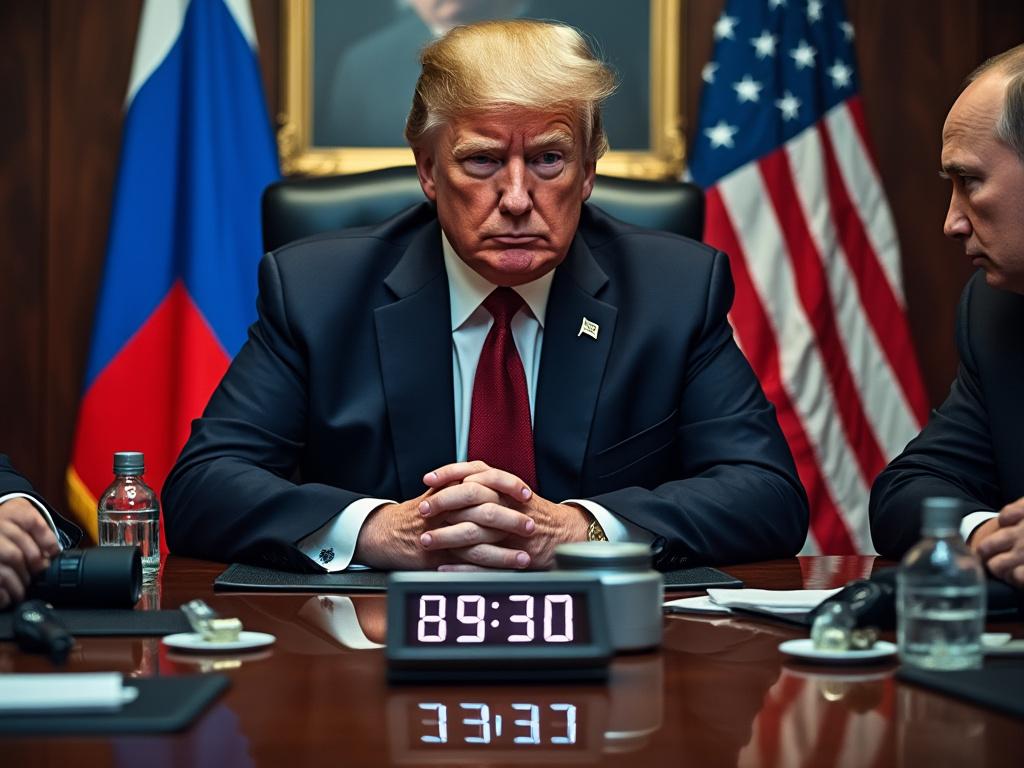
In a critical diplomatic effort to avert escalating conflicts and sanctions, Steve Witkoff, as President Trump’s special envoy, embarks on a pivotal visit to Moscow. This visit is framed by an urgent deadline and the potential imposition of sweeping new economic penalties, setting a tense stage for negotiations.
Trump’s Hardline Ultimatum
In a marked shift from diplomacy to direct ultimatums, President Trump abruptly compressed the deadline for Russian compliance from 50 days to a mere 10. This sudden change occurred after the detection of new Russian military movements near Ukraine, escalating the urgency of US responses. Trump intensified his approach by publicly acknowledging the placement of US nuclear submarines in proximity to the conflicted zone, a rare disclosure meant to underscore the seriousness of his administration’s stance. This strategy, veering towards a show of military might, starkly demonstrates Washington’s dwindling patience for what it perceives as unchecked Russian military aggression and sends a stark signal not only to Russia but also to the international community about the potentially severe repercussions of non-compliance with US demands.
Nature of the Diplomatic Mission
In the high-stakes landscape shaped by President Trump’s stark admonitions, Steve Witkoff’s diplomatic mission to Moscow carries a dual-purpose agenda. Poised for potentially pivotal meetings with President Putin, Witkoff’s objectives oscillate between delivering Washington’s stringent demands and exploring avenues for negotiations and de-escalation. The gravity of these talks is echoed by the cautious optimism from Russian officials and media, hinting at the critical but narrow path towards mitigating further escalations. This interplay captures the essence of a ‘last chance’ mission where the stakes of engagement and missteps could not be higher, particularly against the backdrop of impending sanctions and the pressing urgency imposed by Trump’s truncated timeline.
Sanctions Threat: What’s at Stake
If Russia ignores the US ultimatum, immediate sanctions will trigger severe financial strains, pushing the Russian economy into deeper isolation. These are not isolated measures; the broader impliations include secondary tariffs on nations dealing with Russia, essentially forcing global allies to evaluate their own economic engagements or face US economic repercussions. President Trump highlighted the enforcement challenges, acknowledging that while sanctions are a potent tool, their global ripple effects—potentially destabilizing markets and inflating commodity prices—require careful calibration. He emphasized the strategic motives behind these economic pressures, aimed not only at penalizing Russia but also at reshaping international alliances and trade practices, reshaping power dynamics on a global scale.
Ukrainian and International Reactions
The announcement of Witkoff’s last-ditch talks with President Putin has triggered a broad spectrum of reactions. Ukrainian officials express cautious optimism, yet remain sceptical of the Kremlin’s commitment to substantive peace talks. Many emphasize past negotiations where agreements were superficially brokered, only to be breached by Russia. This skepticism resonates across Europe, where leaders hold reservations about the potential effectiveness of talks given a history of diplomatic failures. The prevailing European sentiment favors a robust framework for negotiations, underscoring the need for enforceability and verified compliance of any agreement reached. This intricate backdrop of international hesitancy reflects a deep-seated mistrust, influencing the geopolitical stakes of this high-profile dialogue.
Recent Precedents and Putin’s Calculations
In examining Putin’s engagement patterns with the US, a distinct repetition of strategic stalling emerges—a tactic employed to potentially gain military or geostrategic leverage. Reviewing summits such as the one in Helsinki (2018), it becomes evident that Putin often employs diplomatic dialogue as a screen, facilitating redeployment or changes on the ground. Such actions, historically observed as incremental escalations or unexpected deployments, can shift the power balance before concrete diplomatic resolutions are realized. Hence, Witkoff’s mission, perceived as a ‘last chance’ by the US, must navigate these historical precedents with caution. The strategy is expected to not only propose feasible solutions but also create contingencies for rapid Russian military maneuvers, ensuring that these talks do not inadvertently provide a cover for unanticipated military actions. The implications of historical insights into Putin’s diplomatic engagements underline the critical need for a tightly coordinated approach that is both politically astute and strategically foresighted.
Conclusions
As Steve Witkoff heads to Moscow, the world watches, hopeful yet cautious. This mission could either pave the way for de-escalation in the Ukraine conflict or spiral into tougher sanctions and deeper geopolitical frictions. The outcome of these talks will significantly influence future US-Russia relations and the broader international response to ongoing global conflicts.