
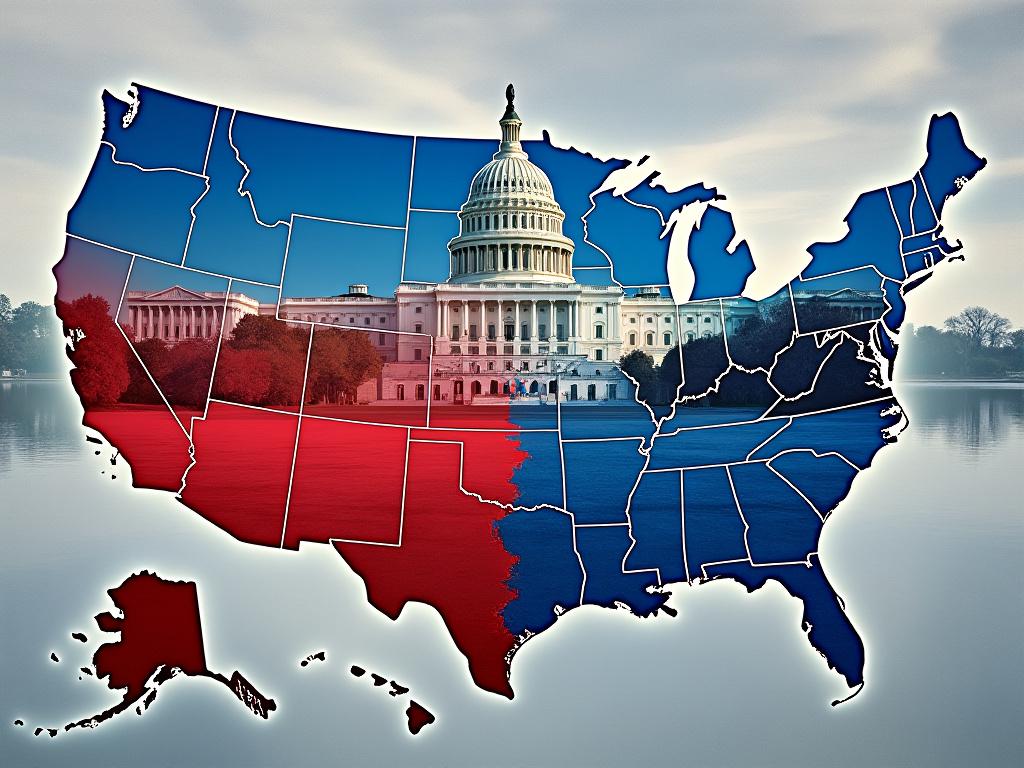
The political landscape ahead of the 2026 midterm elections in the United States is heating up with Democratic governors pushing for aggressive redistricting. This move comes in response to Texas Republicans’ controversial attempts to redraw congressional maps, spotlighting a significant partisan struggle over national political power.
The Texas Standoff
In a high-stakes standoff known as The Texas Standoff, Democratic lawmakers in the Texas state House orchestrated a walkout to halt the passage of new Republican-drawn redistricting maps. This dramatic move was primarily motivated by claims that the proposed maps would disproportionately dilute the electoral influence of minority voters, effectively consolidating Republican power across the state. In retaliation, Republican leaders, under the directive of House Speaker Rep. Dustin Burrows, issued civil arrest warrants to compel the return of the Democrats. The tension thickened as Governor Greg Abbott, siding with his party, intensified the standoff by vowing to enforce these warrants, framing the act as crucial to maintaining legislative integrity. The walkout, and subsequent threats of civil arrest, underscore a profound partisan divide, with acute implications for the legislative process and minority representation in one of the nation’s most politically significant states.
The Role of Redistricting in Political Power
Redistricting, crucial for determining Congressional representation, involves redrawing electoral district boundaries every ten years, following the census. This process directly impacts political power distribution, often manipulated through gerrymandering, where lines are strategically drawn to favor one party. The Texas GOP’s recent map is seen as a stark example, consolidating Republican stronghold by diluting Democratic urban strongholds into multiple disparate districts. President Trump endorsed these efforts, intensifying partisan tensions. With 2026 midterms approaching, such maneuvers are poised to significantly influence electoral outcomes, potentially cementing GOP dominance or sparking Democratic counterstrategies. This strategic mapping underscores the escalating battle for control in America’s fragmented political landscape.
Democratic Response to Republican Moves
In a bold shift from previous advocacy for nonpartisan redistricting, Governor Gavin Newsom of California has taken a proactive stance, galvanizing Democratic governors to embrace more assertive redistricting strategies in response to Republican maneuvers, notably in Texas. This strategic pivot underscores a growing sentiment within the Democratic ranks that equalizing the playing field might necessitate adopting tools historically leveraged by their opponents. Newsom’s leadership reflects a pragmatic acknowledgment that without robust countermeasures, Democrats risk continual disadvantage in pivotal electoral arenas. The rationale is clear: to directly challenge and counterbalance the perceived Republican gerrymandering which has crystallized in places like Texas, thereby safeguarding Democratic interests and ensuring fairer representation. This approach, although contentious, is seen as a necessary recalibration in the face of escalating partisan redistricting by Republicans.
Obstacles and Opportunities in Democratic Redistricting
In navigating the tumultuous waters of redistricting, Democratic governors encounter intricate legal frameworks that vary significantly by state. Many states have established independent commissions intended to curb overt partisanship in redistricting. These commissions, however, can limit a governor’s influence to varying degrees, depending on state-specific rules. For instance, in California and New Jersey, the composition and independence of these bodies are designed to foster fairer electoral maps, often constraining partisan extremes.
Yet, the pressing challenge remains the tight timelines for redistricting, which are dictated by electoral cycles and census data release schedules. This element of timing is crucial; it forces rapid decision-making that can either hinder thorough public consultation or push governors to make hasty compromises. Within these constraints, the potential for meaningful change in the political landscape exists—Democratic governors must navigate these waters cleverly, maximizing their influence where possible while adhering to legal and temporal boundaries. This strategic navigation could reshape electoral districts significantly enough to impact election outcomes and thus rebalance state-level power.
National Implications and the Future of Democracy
As partisan redistricting escalates, the broader national implications draw into question the health of American democracy. This intensifying strategic manipulation of electoral boundaries often tips the scales of power, testing the delicate balance between state autonomy and federal oversight. Historically, disputes have frequently escalated to the judiciary, reflecting a systemic reliance on legal interpretations to resolve what fundamentally are political questions. This trend toward judicial resolution not only burdens the courts but also places them at the center of partisan battles, potentially undermining their perceived neutrality. The evolution of these tactics could further polarize the electorate, entrenching divisions and making bipartisan cooperation increasingly difficult. This trajectory urges a reevaluation of the mechanisms controlling redistricting processes, possibly pointing towards federal reforms. The outcome of these battles will have long-standing impacts, shaping not only the political landscape but the very framework of democratic engagement in the United States.
Conclusions
The unfolding drama of redistricting in the U.S. poses critical questions about the future of democratic governance. As both parties employ increasingly aggressive tactics to secure political power, the essence of fair representation remains at stake. How America navigates these turbulent waters may well redefine its electoral landscape for generations.