
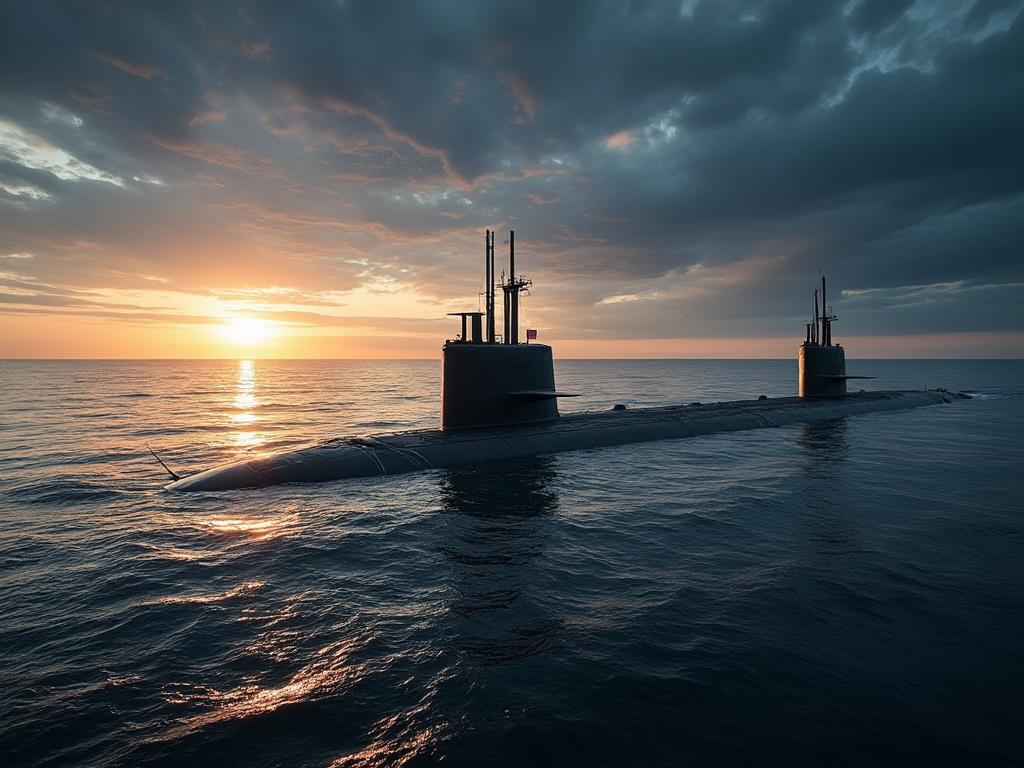
In a bold move marked by geopolitical gravity, former U.S. President Donald Trump has confirmed the deployment of two nuclear submarines near Russian waters. This decision comes in light of provocative remarks by former Russian President Dmitry Medvedev amid a backdrop of heightened U.S.-Russia tensions and military exercises involving China.
Background and Trump’s Announcement
In response to escalating tensions and military provocations near its borders with Russia, former President Donald Trump publicly declared the deployment of U.S. nuclear submarines “in the region” of Russia. This announcement, while sparse in operational specifics, marked a significant strategic statement amid growing concerns about Russian military movements and regional insecurity. Trump’s tweets and statements sought to reassure allies and exert pressure on potential adversaries by emphasizing U.S. military readiness and capability. The immediate implications of this bold declaration triggered heightened diplomatic exchanges and a flurry of international media attention, fueling debates on the limits and potential consequences of such military postures in sensitive geopolitical terrains.
Strategic Context Russia, China, and Naval Posturing
The deployment of U.S. nuclear submarines in proximity to Russia and China represents a calculated shift in military posture, deeply rooted in countering the evolving Sino-Russian military cooperation, particularly in the Sea of Japan. Both nations have enhanced their military maneuvers around strategic maritime areas, pressuring regional security frameworks and tilting the balance of naval power. These U.S. movements, kept classified to ensure strategic ambiguity, aim not only to project power but also to monitor and potentially dissuade further military collaboration between Russia and China. This secrecy simultaneously fosters operational security while sending a clear signal of U.S. readiness and reach, crucial for maintaining a balance in an increasingly militarized region. This posturing informs the next chapter of diplomatic engagements, where the U.S. must navigate the intricate dynamics of military deterrence and diplomatic negotiations.
Diplomatic Maneuvering Special Envoy’s Visit and Sanctions Threat
In response to escalating tensions, President Trump ordered the deployment of U.S. nuclear submarines near Russian and Chinese operational theaters, complemented by significant diplomatic maneuvers. Chief among these was the appointment of special envoy Steve Witkoff to Russia. Witkoff’s urgent mission underscored the high stakes: to deliver a clear ultimatum demanding Russia reduce its military cooperation with China and avoid exacerbating regional insecurity. The failure to comply could trigger severe economic sanctions, which would further isolate Russia economically and diplomatically at a global level. This strategy aims not just to counter immediate threats but to recalibrate the power dynamics in the region, ensuring U.S. interests are safeguarded amidst the growing Russo-Chinese military collaboration.
Implications and Expert Perspectives
The deployment of U.S. nuclear submarines near Russia, as announced by former President Trump, raises significant concerns among military experts and non-proliferation advocates regarding the potential for escalation. Experts argue that such actions increase the likelihood of miscalculations and could escalate into more severe military confrontations. The strategic transparency of this deployment might serve as a deterrent, suggesting readiness to defend national interests while warning adversaries against further provocations. However, contrasting opinions exist, wherein some see this as an unnecessary provocation that destabilizes the regional security architecture, ultimately undermining the strategic stability that prevents nuclear conflicts. These differing perspectives reflect deep divisions on the balance between demonstrating military capability and inadvertently triggering an arms race, emphasizing the delicate nature of such geopolitical maneuvers.
Broader Regional and Global Impact
The deployment of U.S. nuclear submarines near Russia not only escalates tensions but also impacts broader regional stability and global security architectures. Allies under the NATO umbrella may perceive these moves as a reaffirmation of U.S. commitment to collective defense, particularly those in closer proximity to Russian influence. Conversely, nations leaning towards non-alignment or those within spheres of Russian or Chinese influence may view this as an aggressive stance, potentially hardening geopolitical divides. The U.S.-China relationship, specifically, could deteriorate further as Beijing might interpret this as an escalation in the Pacific, a direct challenge to its maritime ambitions. Potential scenarios include a strengthened NATO eastern front, a polarized U.N. Security Council, and a globally heightened state of military readiness, which collectively push towards a more fractured international system.
Conclusions
Former President Trump’s decision to deploy nuclear submarines in response to Russian provocations has intensified global military and diplomatic tensions. This maneuver not only signals U.S. readiness to counter perceived threats but also poses significant risks of escalation. The world now watches closely as diplomatic and military events continue to unfold, potentially reshaping international relations.